
My biggest hurdle when I became a Dungeon Master was balancing combat. The very first time I DMed, my players nearly had a total party kill. Twice.
I was running my campaign the Edge of Evil, which in its original form was mostly a mashup of third-party adventures with my own overarching plot. The Edge of Evil (or “Edge”) is an evil campaign glistening with melodrama, and the perfect adventures to start off with were “The Doom Portals” by Barbarossa. Written for evil characters with helpful DM tips, while also having a super cool plot, these modules seemed like the perfect way to ease into DMing.
Now, this was before I’d been exposed to Critical Role and the like. It had never even occurred to me that I should glance over the Dungeon Master’s Guide. I never used the Monster Manual for stat blocks—all my homemade NPCs were designed as full fledged characters from the Player’s Handbook. Everything I knew about DMing came from being a player in a fellow novice DM’s game.
So, of course, my first session as a DM was an absolute clusterfuck.

The module contained some encounters that would be deadly if the party decided to use combat—but also included ways to avoid combat. The party received kobold disguise potions that would allow them to walk into the kobold cave without suspicion, but my players forgot all about them. They also wouldn’t have ignited too much suspicion if they just walked into the cave as themselves (two humans and a tiefling).
But no. They tried and failed to be stealthy—and that was suspect. The kobolds attacked, and the entire party nearly died. I used the kobolds’ stat blocks exactly as written, and didn’t have the common sense to adjust them in a way that would make the encounter survivable.
Based on the Challenge Ratings of the kobolds, this encounter should have been perfectly survivable. But one of the kobolds was a special kobold: he could do a multiattack with tentacles that almost certainly would one-hit K.O. any first level player character. These players had between 6 and 12 hit points, and this multiattack did an average of 18 damage—enough to not only one-hit K.O. but potentially instantly kill the characters.
But I didn’t write this encounter ¯\_(ツ)_/¯. I’m just DMing it as written. It’S NoT mY fAuLt.
I had an ace up my sleeve that I hadn’t expected to use this early in the campaign: a mysterious dragonborn lady has been watching the party, and when it seems like they’re gonna die, will teleport in, save them, and then teleport away. I didn’t want to use this ace in every single encounter, but it seemed like that might be the way this campaign was gonna go. The mysterious dragonborn lady popped in, saved the party, and popped out.
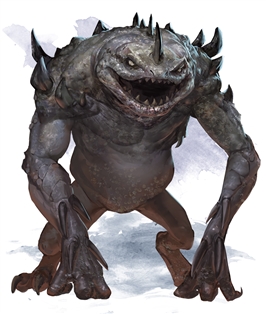
Did I learn from this experience that the encounters in this module were too challenging as written? Nope. The party proceeded into a cave, at the end of which a death slaad in the form of a dragon wyrmling slumbered on a pile of copper pieces. Remember: the party was at first level. This modified death slaad-dragon wyrmling was CR 10—a balanced encounter for a party of four tenth level characters.
Beau, our lawful good paladin, decided to pick up a piece of copper.
Now, the module was not prepared for this. The dragon was supposed to continue to slumber until summoned by a magical ruby. What was I to do? Have the dragon immediately attack the party of three first-level characters, of course.

I was a pretty dumb DM, but I wasn’t that dumb. I knew the party would all die if the dragon hit them even once, so I decided to be “clever” and have the dragon attack the kobolds by accident. This bought time for the one round necessary for the ruby to get activated—which would force the dragon to become aggro on both the kobolds and player characters—and initiate the chase sequence.
The chase sequence went mostly as scripted, and the party was able to survive this first adventure of theirs! And my players went on to berate me for putting a dragon in the very first adventure.
“But I didn’t write this!” I exclaimed.
“You still have to read it and make adjustments!” my players countered.
Take ownership of premade adventures.
I am ashamed to admit that it took me a long time to finally realize that I can and should make changes to written modules—even on the fly in the middle of a session. I constantly used “I didn’t write this” as an excuse for why my players’ characters kept dying. (And they did die. A lot. I discuss this in another post.)
So, dear reader, I behoove you to take home one piece of advice: actually read and process the module before DMing (including the numbers in the stat blocks), and make adjustments to avoid player character death. The players’ characters shouldn’t be getting a total party kill from a scuffle with some kobolds. An easy way to do this is to half the amount of damage rolled when you know the full amount will kill them. While you should aspire to have encounters balanced enough where you don’t have to fudge any rolls, it’s a lot better to fudge a roll than to kill the entire party.
Have any stories of terrible first sessions? Please tell me about them in the comments!
 Delayed Blast Fireball
1 thought on “My Terrible First Session as a DM”